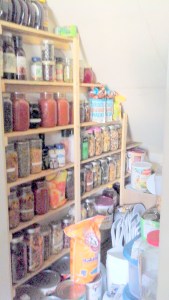
At one time I had no basement or garage, but I did have a closet located beneath a stairway. With very limited wall spade I built shelves the depth and height of a 64 ounce mason jar. I built these on facing walls. At the back of the closet, I added one deeper shelf across the lowest height of the area. This is where I stored canning supplies. It was crowded but worked. I used 1″x 4″ lumber for the shelves. For the vertical and horizontal supports for each shelf, I used 1″ x 1″ lengths.

This pantry area was located in the tiny room next to the pantry beneath the stairway. I built it using 2″ x 3″ lumber for both the vertical frame and horizontal shelf supports. I used the mason jar cases as measurement for the depth of the shelves. Sunlight found its way through the window and curtains. To help protect from the light, I attached sheets of toweling to the shelf front. Large pots and other canning supplies were kept below, and empty jars on the top shelf.
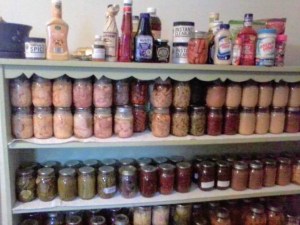
In another home I used an empty room for my food storage. Optimizing bookcases for food storage.

Bookcases, wire shelving, shelves mounted to walls, stacked crates, old cabinets. Anything can be used as low cost storage for your food supply.

A bedroom closet with wire shelving also serves as pantry storage space. We added a few more shelves inside the guest room closet at my in-laws condo.

A basement that remains cool and dry provides adequate space for a large pantry. Use metal shelving, build basic wooden shelves, or even use old kitchen cabinets leftover from someone’s kitchen renovation.
There is no are too small or too large for creating your food storage pantry. We are limited only by our imagination.
 Our Simple Homestead